Iceland by the numbers, Learning with new friends

There is really no night so Wendy and I woke up and went on a photo shoot at five in the morning.
It was a delightful walk through the town and down to the bay. When we returned to the hotel we ate breakfast. The bus departed at 8 am for a long day of driving.

The first stop was a horse farm where we tried to photograph movement. Wendy’s goal for the day was to use all manual photography. She did a great job, I have a long way to go. We ate at the horse farm, Wendy was shocked that horse meat and minkes whale steaks were on the evening menu. We had a soup and salad buffet for lunch. We wondered if they change the menu for American tourists. The horses are Icelandic horses, not ponies. They have five gaits, most horses have just three. These horses make exceptional therapeutic horses. In horse country, there are 150 horses for every person.

We drove to Aukreyri, the second largest city in Iceland. Along the way we stopped to photograph
Mountains and visited sod houses, one of the shelters for early farmers.

The group is starting to jell. People are taking time to share their talents with others. Alice, who keeps a sketch journal, Bruce who is a photoshop instructor, and Bobby who is a semi pro photographer are eager too help others. After dinner tonight people were sitting in small groups sharing pictures and ideas.

The hotels on this trip are not as fancy as other tours I have taken, they are small inns in the country. The food is alway fresh local fare, lots of fish and always fresh baked whole grain breads. The yogurt, is called skyr and surpasses Greek yogurt. Breakfast is often cheese, smoked salmon, ham and tomatoes.

Iceland numbers

The population of Iceland is just over 350,000 clase to Ann Arbor on football Saturday
The land area is about the size of Kentucky.
Length of shoreline is a little larger than Michigan
Water heaters are not needed, the water is pumped from the ground to the house at 119 degrees
The fox is the only natural animal, reindeer were imported.
Corrugated steel is the house siding of choice.
All the trees were cleared by early settlers, there is some replanting happening now
3 things that cannot be counted- mountains, islands and highland lakes
Mortgage rate is 4%
Gas is $2/ liter
They are self sufficient in meat and root vegetables, much of the other food is imported

The island lore is fantastic. We passed one rock that split in two when the church tried to drive out the pagans with holy water.

It has rained all night, we will still be going out on excursions

Rocks, Glaciers and Fish soup

Today we drove along the west coast stopping for photo ops along the shores and glaciers.

Our first stop was a mall to pick up a camera battery for one of the participants who came without. Eric, our guide managed to order one for her online, have it charged and waiting for her at this first stop. Several of us splurged and bought Puffin Hats. Nothing says American tourist like five adults strolling through a parking lot with Puffin hats. Cathy Campbell,I hope you like this better than the last hat, which is not warm enough for Iceland.

The colors and the contrast in this country are amazing. I have about 15 shots of everything and still don’t feel like aim capturing it.

The food has been remarkable. I did conquer “one I won’t” today, I actually ate fish soup.

Other world and outclassed

We must have left Michigan just in time. We missed the rain and had only a short delay in Boston. The flight to Iceland was a nonevent, not even long enough to catch some sleep, so we have been running since yesterday morning with no sleep. Customs was a big surprise, they just nodded us through and said have a nice trip.

The group, 19, five married couples, a grandma/granddaughter combo and the rest retired females. A very interesting,highly educated group, most have either won photo contests or are actively engaged in photography beyond family pictures. I am definitely outclassed on this trip.

After the airport, breakfast and trip orientation we went to the famous Blue Lagoon. The lagoon was formed by industrial effluent from the worlds largest geothermal plant. The plan was the waste water would run off and be absorbed by the lava beds surrounding the plant. The runoff is so full of salts that a thick floor was formed, the water could not drain and the lagoon formed. After many years of people “sneaking in” to the plant property for a good hot soak it was decided that it would be opened to the public and is now the number one tourist attraction in Iceland. This was a fabulous restorative hour.

We drove to the sea and photographed the large lava formations. The roadside is covered with blue lupine which has been imported in an effort to add more nitrogen to the soil. We also stopped to see gysers, where the surface temperature is so hot that the surface bubbles and steams. Our last stop of the day was a point where the Eurasia plate and the North American plate meet, the official geological line between the two continents.

So far Iceland looks like a moon scape cluttered with lava rocks. Below the surface there is grinding, sifting rock that is creating pressure and heat enough to power the country. Volcanos are a yearly occurrence.

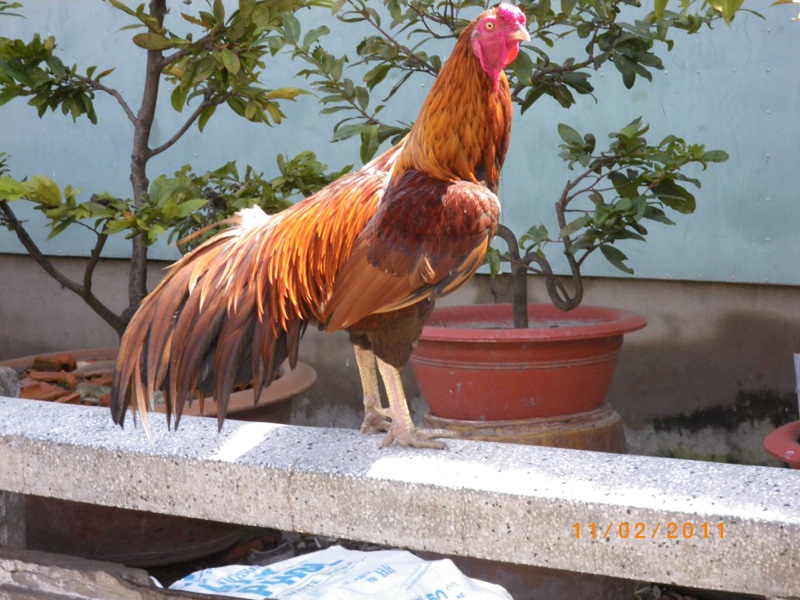
SOMETHING TO CROW ABOUT

something to crow about!!!

something to crow about!!!

When I was growing up and we traveled, my Mom always kept a travel journal with three carbon copies. She would mail the carbons to the Grandparents and her sister so they could “share” the trip. The original was always stored with my Dad’s slides. When he would show his slides she would follow along with the journal and make sure his narration was accurate. I not only felt sorry for the people who got the carbons ( after I was married I started getting them), but I thought this was pretty corny.

When I started to travel I saw the wisdom of a journal. When I went to Turkey I had access to a computer so I blogged on Moodle. When I retired I decided to start my own travel blog. This blog has several advantages, it forces me to make accurate descriptions of the day each night before I jump into bed and I don’t have to send postcards. ( my kids think this is pretty corny)

My blog has been ok, but I knew that it could be better. This spring I took advantage of the free courses offered to old people (over 65) at WCC, Life Long Learning. I took a WordPress Class from a very patient instructor, Dee Overly, who was marvelous. With her guidance I ripped apart most of my blog and redid many pages. I learned a ton and I am eager to begin my next trip. In a few weeks I will be leaving with Wendy Beckwith for Iceland. We are taking a ROADS SCHOLAR TOUR. We will be site seeing and learning photography. Wendy will be adding some of her thoughts to the blog.

St Augustine said ” the world is a book and those who don’t travel read only one page.”

I’m off for another page turner.

LATE, LAST, BUT NOT LEAST

Model for ET

Model for ET

 About thirty years ago I heard a radio show about the Galapagos Islands.  I asked my craziest ,most adventurous friend, Mary, if she would go.  It required and boat and held no promise of shopping so Mary said no.  I have dreamed of a Galapagos adventure ever since.

 The reality did not disappoint.  The environment is pristine.  I watched local guides go out of their way to clean up the very few thoughtless messes that tourists left.  The water is crystal clear and the animals have no fear of humans.

 We stayed on one of the few licensed boats that is allowed to bring tourists to the islands.  Everyday we had two excursions from the ship via Zodiac to the island of the day.  Every night we watched from our cabin window as the sea lions, sharks, sea turtles, frigates, pelicans and flying fish played survival of the fittest.

 The Islands were formed by volcanoes and are still in an active cycle of formation and destruction.  We hiked in a lava tube, one of many on the islands.

The islands have served as a stronghold for pirates, a military base for the US government and a living laboratory for Charles Darwin.  In 1959 the Ecuadorian government named the islands a national park, in 1979 it was named a World Heritage site and in 1985 a World Biosphere Reserve by Unesco.  

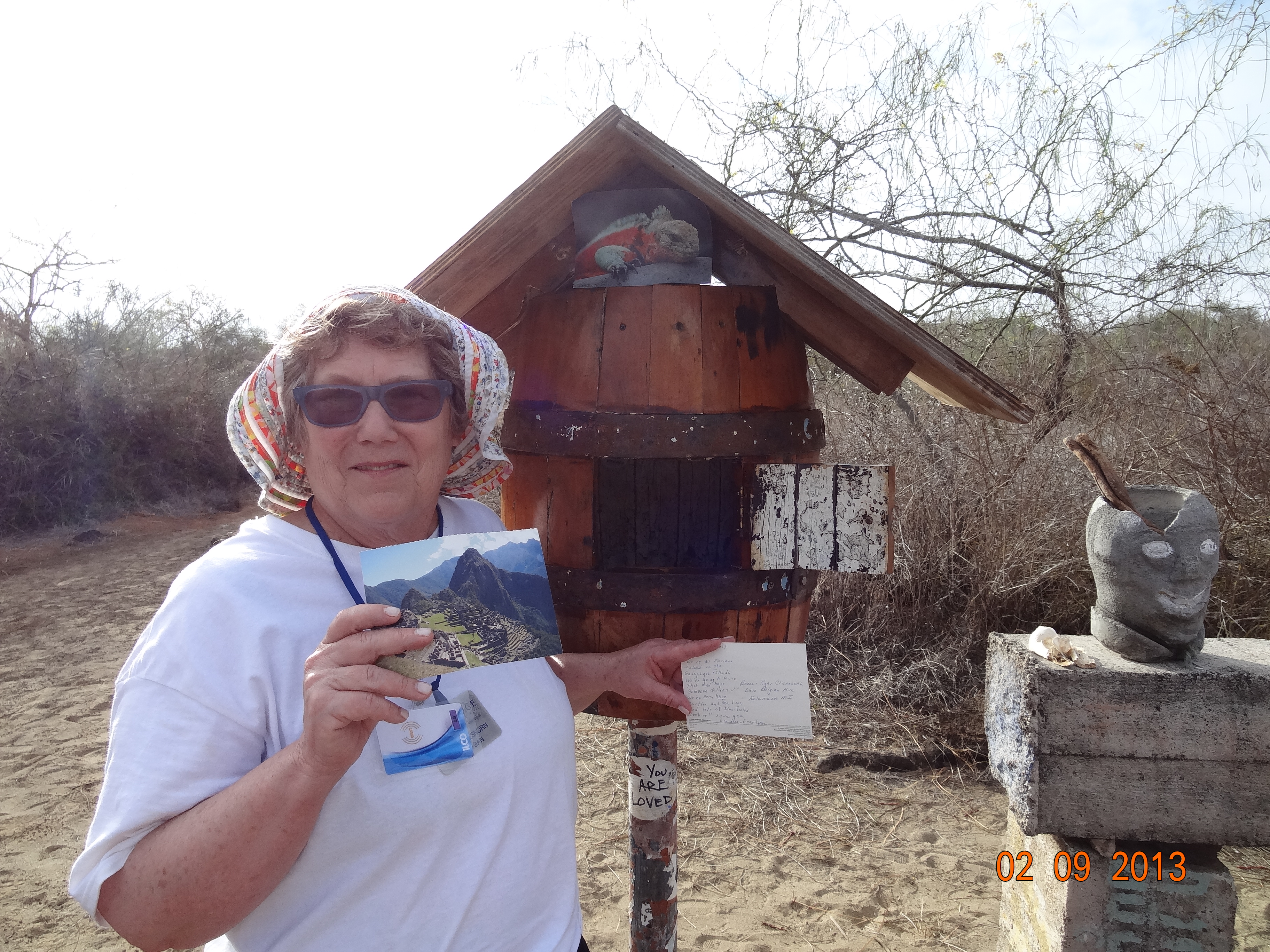
 One of the points of interest was the POST OFFICE. 

pirate mail box that is still in use

pirate mail box that is still in use

A barrel installed in 1793 served as a drop off point for letters.  A person dropped off letters and then sorted through those left and  took for personal delivery those close to their destination.   I left one for San Francisco ( attn Millers)  and took one for Kalamazoo   ( the Chenoweth family).  

 We made three attempts at snorkeling.  The first off Gardner Bay, recently named one of the ten most beautiful beaches in the world, was billed as the least attractive of the snorkeling spots on the trip.  It actually turned out to be the best.  The water was clear and warm, the fish were colorful and plentiful.   The Parrot fish, whose eating and pooping of   the local coral is responsible for the ultra soft sand, were abundant.  Maggie was accompanied by a sea-lion who caressed her body as he swam above, below and to the right and left of her. This is one time in life where Maggie’s magnetic attraction to the males of all species did not cause any jealously in my bones. 

 The second snorkel trip was limited by a jelly fish hatch which stung several of us.  The third and most disappointing was ended by a strong current.  

 During the days of pirates, the islands were loaded with the giant land tortoises.  Pirates would take hundreds of them off the island and stack them, alive, on their back for fresh food on the long journey.   The Charles Darwin Station is making an effort to breed tortoises back to historical levels.  ( our guide informed us this could take up to five more generations)  Eggs and the babies are carefully marked so they are released to islands where the native DNA matches theirs. 

 Sea turtle nests are also protected and monitored.  The sex of sea turtles and alligators are determined by the placement of the eggs in the nest.   Eggs closer to the top and the heat are female and those lower and cooler in the nest are male.  (hot chicks and cool dudes-memory device shared by our guide).  

 Nazca Boobies,

Blue Footed Booby

Blue Footed Booby

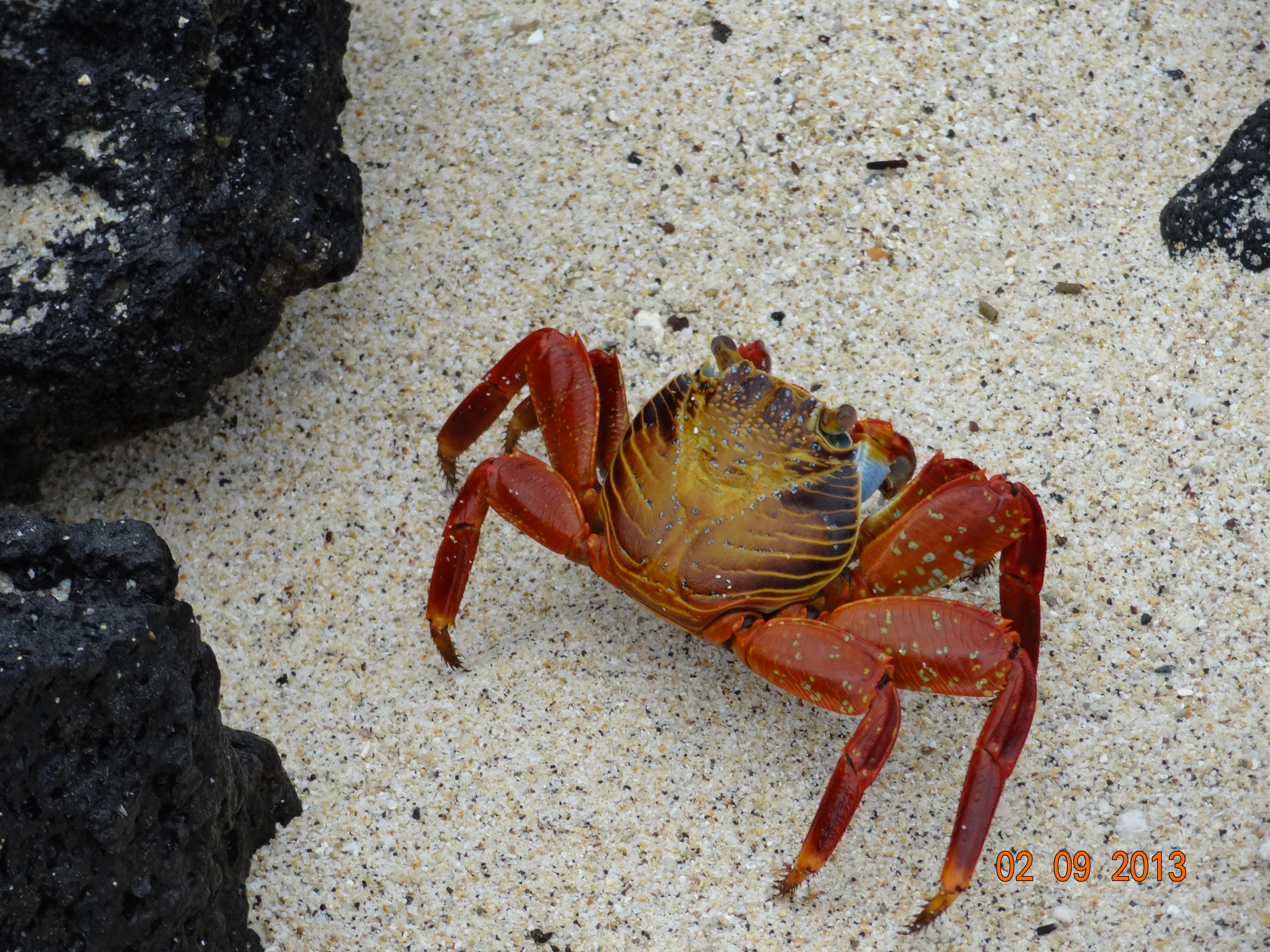
Blue Footed Boobies, Albatross, Sally Light Foot Crabs, Finch, Hawk,  Iguanas  and sea lions were abundant at most stops.  <A living laboratory, a zoo without cages, this was definitely a trip of dreams.  <

HATS OFF TO ESTHER


Final Reflections / Hats off to Esther!!!

The impulse to travel is one of the hopeful symptoms of life.”

–Agnes Repplier,

American essayist

I have begun to classify the trips on my bucket list by the amount of strength and agility I perceive they will require.  I witnessed 2 parties that were eighty or older on this trip that taught me a lot about my future plans.

betty crab

betty crab

The one couple had obviously not read the travel material. Their clothing and shoes were inappropriate for the trip.  They were totally unprepared for the altitude and the wife became very sick because of the altitude.   I need to read every piece of information before a trip and I need to continue to consult doctors before

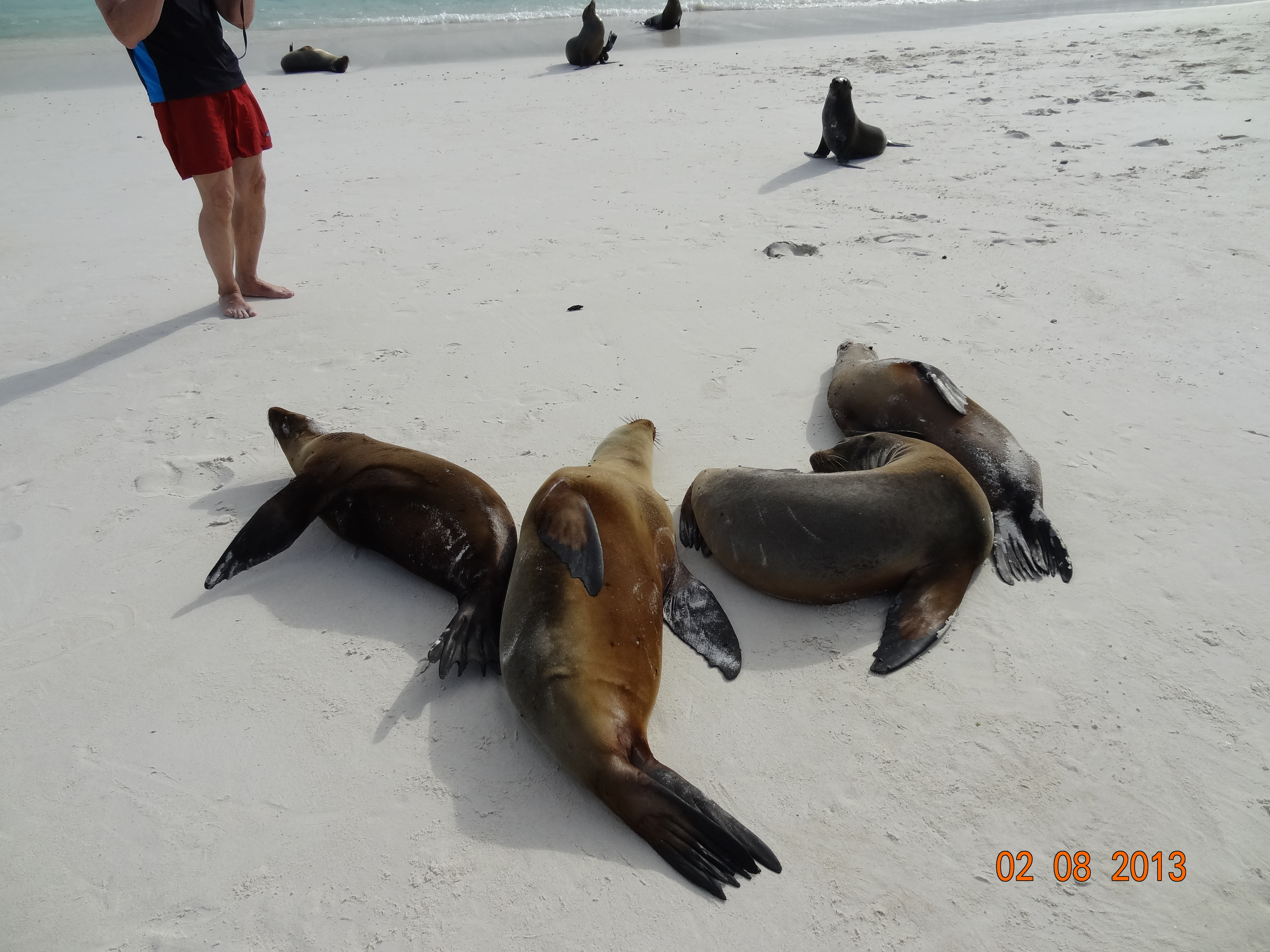
afternoon nap

afternoon nap

travel.

The altitude sickness was no joke.  It was not, as I heard my friends warn me,a matter of my asthma.  Even Maggie, who is more athletic than I will be in 10 lifetimes combined and lives in Denver was affected by the altitude.  The International Heath Medicine practice here in town gave me drugs to deal with the effects.  The drugs combined with the local coca leaves and tea were helpful.  Apparently altitude sickness affects your digestion and some of what we thought was travelers diarrhea was in-fact caused by the altitude and the quantity of food we were being “forced” to eat.

The other party was Esther, my new hero.  Esther is 85 and never missed a trick the entire trip.  She travels to many remote and exotic places, ( her next stop is a Bengal Tiger Reserve in India)  always reading before the trip, planning her simple wardrobe and rising to every challenge along the way.

I need to push myself both mentally and physically if I want to continue to travel.

My next stop is Iceland with Wendy Beckwith.  June – July.

More Quito

Today we stood on the equator. Out first stop was the middle of the world monument which was built by the French to celebrate the French and English expedition to prove the world was round and the equator was the center. Once proving it they named the land Ecuador meaning equal. When the country gained independence the kept the name.

A few miles down the road we went to the equator museum where we participated in demonstrations showing the effects of being in the north,south or exactly on the equator. On the equator your shadow diapers at the equinox, other wise it is either east or west of your body, depending on the season. The indigenous population used a sundial to tell them when to plant and when to harvest. The days on the equator are always the same length, 12 hours daylight and 12 night, there is no real season change except for wet and dry, you can always see the Big Dipper, Orion’s Belt, and the southern cross. We witness the true corollas effect with water and a drain, it actually changed by moving to the little sink a few feet away from the equator. We tried balancing eggs on a nail, only two people were able to successfully balance them. While trying to do the balance test typically given given by police to drunks we learned that your inner ear cannot compensate while on the equator. It was amazing that the effects of the equator can be felt a foot off of 00*.( bulletin, I ate breakfast with a doubter and he thinks it was all hokey)

It should be obvious by now that the person leading this tour loves,excellent food, good drinks and entertainment. Every place we go for a meal it is as if he were inviting you into his private home to serve you the best possible food. He loves a show of great ambience also. Lunch today was at a restaurant owned by two artists in an exclusive development on the edge off an old volcanic crater. Quito is surrounded by eleven volcanos. The dessert was poached (?) figs. This is second time we have had them and they could easily become a favorite.

Next stop, a cable car ride to the top of the city. The view was fantastic but the clouds hung so low that my pictures all look like I was stuck in a wad of white cotton candy.

Dinner on our own tonight with our new best friends Carol and Jim. Nothing fancy, just individual pizzas and wine in the hotel deli.

We watched the Michigan, Ohio state basketball game with Spanish commentators.

Wednesday

Our adventure the morning took us to the city center where we visited churches,all Catholic, and all dripping in fabulous art and gold leaf. Maggie is constantly reminding me about the greed of the church as well as the harsh ways they used to convert the natives to Catholicism. Ecuador at one time made Catholicism a requirement for citizenship.

Continuing on a theme we ate at another fabulous restaurant with figs for dessert
Tonight we have a festive city tour, a dinner with opera singer as the entertainment

Thursday we. Leave for the Galapagos where there will be no Internet connection. I will catch up on my seven hour lay over in Miami.

Quito

Quito

We left Cusco and had a long arduous journey to Quito. When we finally got through customs and loaded the bus we were all a little short on patiences. We still had a two hour journey to north of Quito which just seemed like a bridge too far. We finally made it to Hosteria Pinsaqui, an old hacienda that had been in the owner family for nearly three hundred years. It was Simon Bolivars favorite stop when travelling between Ecudor and Columbia. The room doors were all original with the old heavy brass keys. Each room had a wood stove for heat. The ambiance was restorative. Dinner was served in the large original dining hall. After dinner we returned to the room and surprise our wood stove had a fire and the bed had shot water bottle dressed in a little terry cloth robe. Bed was to inviting to resist.

In the morning we began the drive south back to Quito. Out first stop was a rose farm where we learned a out the production of roses. We visited the green houses that are planted with row after row of roses organised by color. The help begins each morning by cutting the roses that have tight buds. Unacceptable roses are put in a container and dumped in the trash. The trash pile was enough to make me weep, beautiful roses that just didn’t,t meet the standards set by the market. Cut roses are wrapped and moved by conveyor to be washed in soap, sorted again, packaged and then cut to the proper length. (The Russian market prefers an 18 inch while the US market looks for a 12 inch stem.) This farm ships 80,000 roses a day to Russia, US and Europe. All these roses are bred for looks and not fragrance.

Our next stop was the Otavalo Market, one of the largest indigenous markets in the world. Crafts, clothing, fresh foods and home goods.

Lunch was at a cultural center. Native soups, breads, chicken and Guiena pig were on the menu. One pass at a Guiena pig is enough for me. There was a local band and children dancers who entertained us.

We arrived at the hotel at about 630 and were off to another native dinner and more music.

The amazing Incas

We returned to Machu Picchu today to climb to higher heights. Maggie and I did not get our wake up call so we rushed through breakfast which meant no time for coca tea and no time for my altitude pill to start working.. We began climbing very steep steps, everyone was winded but I was not recovering as fast as the other days. I opted to turn around and spend the morning exploring by myself. After two hours I returned to town to site see until after lunch.

Lunch was at another fabulous buffet. After lunch there was shopping and the the train back down the mountain.

We had another long bus ride to Cusco for a two night stay.

Saturday Feb 2

Cusco is a lovely city with a very large square, built originally by the Incas. When the Spanish came they decreased the size of the square by building several streets of shops.
The Spanish also built a very large cathedral with a basilica. The art, silver and gold that adorns the walls,niches and side chapels is stunning and mind boggling. When the church was built the people in town pleaded for prime spaces to decorate with commissioned art work. There is a solid silver carriage that was pulled by horses. It has been converted to ride on a golf cart and is used for religious festivals. My favourite is the Last Supper painted by Zapota(?)) the food on the table consists of Andean bread and cheese and a roast Guinea pig. The face on Judas is the face of Pizzaro the Spanish conquistador.

We visited the Korichana, the sun Temple which has been converted to a Catholic Church. The architectural skill of the Incas is still maintained in parts of the building.

We stopped at Sacsayhuaman, an Inca fort that was never completed. The size of the stones and the shapes they are cut I so that each stone fits perfectly against the next and has remained in place several hundred years without mortar.

After a quick stop at an alpaca factory were we hosted in a private home for lunch. The meal was all native dishes made from ingredients purchased at the market that day. The surprise treat was Guinea pig. It is a greasy, stringy meat with small bones, one piece will last me a lifetime.

Evening free time was spent shopping the small stands for souvenirs that my kids will eventually donate to goodwill or toss.

In the Clouds

We began the day with a visit to the local corn beer bar. We learned how to make corn beer and we sampled both the plain and the strawberry flavoured. Of course the strawberry was my favourite. As we walked a round this local bar we saw the Guinea Pig barn. Everyone raises a few Guinea pigs for that special dinner, weddings graduations…. In the market there is always at least one vendor selling grass to fatten the little buggers. Our guide tells us the trick is not to name them.

After drinking we played the local coin toss game. A small table with a drawer has a metal frog with an open mouth anchored in the centre, around that are several other holes for the coins to fall into. The coin is about the size of a quarter and the weight of a
Silver dollar. At ten in the morning, after a glass of strawberry beer this game can be very entertaining.

Next stop, Inca Railroad, the train up to Machu Picchu, the ancient Inca village. Their was a light rain and the clouds were hanging very low. I have been very concerned about this part of the trip because of the altitude sickness and my asthma. We walked for about three hours, up and down stone stairs of varying widths. Our guide, Edgar
Is very knowledgeable, he is a trained guide which requires a four year degree, he has a Phd, and is a consultant for National Geographic. Among the amazing things he shared with us new theory on the orientation of Machu Picchu. The mountain structure is between four mountains, one in each of the cardinal directions and the river from the sacred valley runs by all the mountains.

The method of building required no mortar. The walls, doors and windows are all trapezoidal. Many of the rocks were from the top of the mountain. They were cut and hauled down to form the large terraces,

When we returned to the hotel we celebrated Pisco day. We learned to make Pisco sours, the national drink.

I may have mentioned this already, sorry, the national population is three women for every man. This is further complicated by the number of gay men.