The land of the incas

13* South

Tuesday Jan 28- Jan 30

Tuesday we took the boat to Iquitos, the bus to the airport, the plane to Lima, another plane to Cusco, a bus through Cusco to our fabulous hotel, Casa Andia, Private Collection. This journey took most of the day. The only unscheduled stop was Bembos Burgers, the most popular fast food store in Peru.

I also lost my innocence today. We drank coca tea and chewed the leaves as a preventive.

Dinner was exquisite with the requisite Andean harp player. This is the night that the rest of people joined trip. There appeared to be no problems until today when one of the older ( than me) women fell down stairs, fell getting on the bus and was barely responsive until the guide sent her to the local doctor. She is suffering from altitude sickness.

Our first stop today was a women’s weaving cooperative. They demonstrated the hand spinning techniques, and the natural dye. The red dye was the most amazing, it was made from a crushed bug that is a parasite on one of the cactuses. It takes one woman thirty days to make a table runner for which they charge $225 solaces or about $75 American. The woman dressed in native costumes. Each tribe has a distinguishing characteristic, this group’s was braided hair. Many purchases were made, sweaters, table runners and hats.

On the bus ride to lunch we learned about the history of land ownership in the Scared Valley. At one time all the land was owned by six families. The government bought the land and distributed it among 350 families. The large land owners were allowed to keep their houses and the reduced plot of land. We had lunch at one of the old plantation houses, Tunupa. The house has been restored and is very spectacular.

The major crops are potatoes (380 kinds), barley,quinoa, asparagus, coca and corn ( apparently) with the largest kernels in the world.

The last stop was Ollantaytambo, the best preserved of all the Inca sites and a still functioning Inca Village. I was faltering on the climb up but one of the guides stayed with me and cheered me all the way to the top. I dubbed him my hero and gifted him with beer.

I am the Champion

I am the champion

I am the champion

Monday

It started raining yesterday afternoon and continued through the night. A long storm is known as a female storm, a violent storm is known a male storm. The river was at an extreme high last May when it peaked, they are expecting an equally high level this May.

We skipped the 5:30 am bird watching adventure.
At breakfast we were joined by a female doctor from Wisconsin who has spent the last 22 years as a doctor in the Amazon. She said nothing she does resembles modern medicine, she works from a bare bones clinic that is the only source treatment for the local population. After several years she has been able to train enough help so she can return to the US for six months every year and work in an ER room to hone he skills and earn a modest living. She was at the lodge waiting for a ride into Iquitos to pick up supplies for her annual vaccine day.

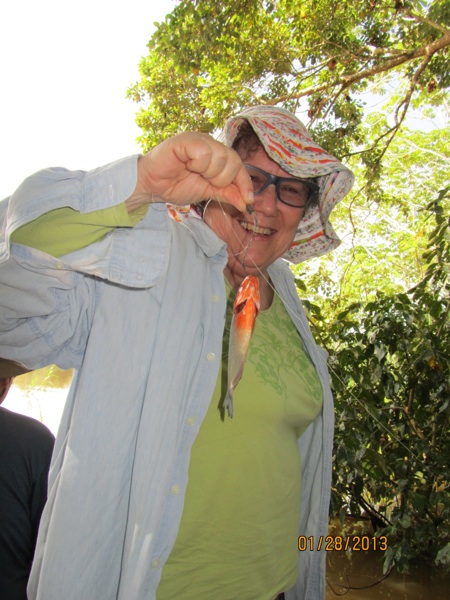
Our morning activity was piranha fishing. I am the champion, I caught the first and largest piranha. I also caught a catfish, making me the winner for the most fish.
The time in the boat is wonderful. Next to the air conditioned room, it is the coolest place to be.

The afternoon was spent traveling the manmade shortcut between the Amazon and the Napo river. Before the road was constructed it took 16 hours to take a boat around the peninsula separating the two rivers, it now takes twenty five minutes to travel between the rivers. Thesis a real asset for farmers trying to move crops to markets.

Again Paul told us stories about the various medicinal uses for foods. He pointed out a tree that produces a fruit that is beneficial for woman. When the tree rots and falls over the woman wait for the. Men to split the tree open. It is usually filled with maggots that the women consider a sweet treat. Men do not eat the maggots or the fruits.

One of the national dishes of Peru is called Juanes. It is the food eaten on the feast day for St. John, June 24. It is rice, chicken, olives and a hard boiled egg wrapped in babjac leaves and boiled. We seasoned it with a tumeric sauce. We had some for our last dinner in the Amazon.

Tuesday is a day of travel by bus, boat and plane to Cuzco.

Meeting the amazon

3* south

Friday was a full day of travel. Wendy picked me up at noon From my house to The airport, then to, Miami,then Lima, another flight to Iquitos, a bus ride to the boat launch and then 45 minute boat ride up the Amazon to the Ceiba Tops Explorama lodge in the Amazon Rain Forest was a 26 hour trip.

After we unpacked, we took a short walk in the forest to see some of the unusual plants and birds.We were accompanied by a Tapir. We saw tarantula holes, golden orb spiderwebs, mushrooms and the large tree, ceiba, for which the lodge is named.

After dinner people quickly returned to their rooms for a good nights sleep.

At 5:30 AM some of us got out of bed to travel up river and see the Sunday market in the town of Indiana. Our local guide, Paul stopped frequently to explain the medicinal properties of every plant. Termites nests for mosquito repellent, papaya for digestion, a
Combination of several plants to rid the stomach of the parasites that invade the stomach and intestines of people who swim in the river. There were many kinds of fish, the Amazon has over three hundred kinds of catfish. Other meat sources included chicken, venison and Paccar, a huge rodent.
On the ride we looked and saw serval pink dolphins.

After breakfast we traveled by boat to a site of the Yagua Indians. Here we witnessed part of their culture, canoe carving, blow guns, weaving of the leaves for roofs and the local dancing. Mary, I can hear you questioning the authenticity of this adventure. Think of it as the Greenfield Village of the Amazon. It supplies a small income and keeps the culture alive. In the pictures below there is a quiver for the arrows. Piraña teeth are part of the hunting equipment, they are used to sharpen the arrows.
In the afternoon we traveled by boat to an animal rescue farm. The monkeys, sloth and birds were very entertaining but the snakes, anacondas and boas, were terrifying. I wonder what you have to pay an employee to bring a 10 foot anaconda out of its pond space and show it to tourists.

The life of any of the people here is one of subsistence, fishing, farming, a few skinny chickens. If you are lucky you have a job in the lodge, own a water taxi to transport people 50 miles to work, sell produce in Iquitos or own a small motorcycle taxi to transport people to market.

Paul found another plant miracle drug which he claims stabilises your blood sugar and controls diabetes. I have heard many people say the cure for most of the illnesses we have exists in the rain forests…are these cures of the natives myths or is western medicine as resistant to these natural cures as we have been to acupuncture.

After our dinner we were entertained by dancers from Indiana high school. They perform to earn money for school supplies.

The company, 3 couples and Maggie Conger, has been delightful. My only complaint is the heat. I have been dripping wet since we arrived. Good friends of mine will remind me of this next time I am ready to book another adventure tour in the tropics.

LAST DAY REFLECTIONS

Today is the last day of the trip. We drove to Montezuma Castle, the settlement of ancient farmers of the Verde Valley. This spot was reminiscent of Catalhoyuk in Turkey. These condo like structures were built in the side of the mountain, it was a hunter a hunter gather society. They abandoned these structures around 1400.

We stopped in the Old Town section of Scottsdale for lunch and more shopping (yawn).
We ate a restaurant that brews it’s own root beer.

I will be happy to resume my daily routine, Morning Joe, Chris Todd, Brian Williams and Rachel Maddow, exercise class and after school time with Drew. This trip did reaffirm that I should not buy an RV because the sheer drops off the side of the road and the hairpin curves are more than I can handle. I do need to find a way to travel in North America that allows me more freedom of choice. The tour is nice because you always have interesting conversations but the damn rules did thro me over the edge one day.

This is the last blog entry until January from Machu Picchu.

A BIG HOLE AND A BIG BORE!!!!!

This slideshow requires JavaScript.

Grand Canyon is an incredible sight from every viewing site. There are NO words to describe it. We traveled to several viewing points, my favorite, Hermits Point. There is a little lodge designed by Mary Coulter( fact check me on this). The view is terrific but the structure has a beautiful stone fireplace built with local stones. Teddy Roosevelt, made the canyon a national park, used to come and sit by this fireplace.

Interesting facts- only 10 visitors a day are allowed to ride the mules down into the canyons, the average visitor looks at the canyon for 15 minutes and then spends 40 minutes in the gift shops.

After a tour, considerable free time and lunch in one of the historic lodges we hit the road for Sedona.

We drove through Oak Creek Canyon which was an entirely different experience than the previous canyons. This canyon was filled with trees, running creeks, swimming holes, fisherman, swimmers and cottages.

Sedona, while beautiful was the low point the trip. Apparently we stayed here two nights so the tour company could host a dinner for the participants, each bus was on a separate night. Our dinner was Saturday night and was excellent.

Sunday morning we went to Sedona for a trolley trip up to the lovely Chapel of the Holy Cross. The architect built it to honor her mothers memory. It was intended for a site in Europe but WWII changed that. When a site was selected in Arizona it was on
government land. Intervention by Barry Goldwater ( a great GOP member who defined conservative before the tea party was born)< moved the project along. The chapel is fantastic with a remarkable view. It was worth the stop.

The downer was the four hour stop at Tlaquepague Gallery Mall. The travel company obviously did not know it's audience. Base price at most shops was $250. After this stop we returned to the hotel for??????. At 530 the buses loaded again for more shopping and dinner. Gayle and I opted off the bus and went to a restaurant that had an intriguing logo and name, THE BARKING FROG. Murphy, you can judge a resturant by it's cover. What an adventure in southwestern dining.

In my opinion we could have seen the chapel and moved on to Scottsdale and another national park.

Glen Canyon and Lake Powell

This slideshow requires JavaScript.

Friday we traveled to Glen Canyon Dam and Lake Powell. Glen Canyon, and Grand Canyon were explored by Powell, a civil war officer who lost his arm at the Battle of Shiloh. Powell filled in the unknowns on the map about the canyons. Eisenhower created the dam that filled the canyon with water and gave the southwest Lake Powell, a source of electricity and a reserve of water to use as a hedge against drought. The canyon floor sits about 300 feet below the surface of Lake Powell.

Eisenhower fired the dynamite that opened a canyon wall from his desk in 1956. It took 10 years to build and 18 years to fill it. The highest water level was reached in 1983. While it generates electricity the Navajo power plant which can be seen from the lake is one of the only “clean burning coal” plants in the country. The tribe installed the highest level of scrubbers available to prevent pollution. The Navajo plant generates more electricity than the Glen Canyon Dam and the Hoover Dam combined.

Later in the afternoon we had our first view of Grand Canyon. The Native American word Kanab, which is used to name many forests and town in the area, means upside down mountain. This is an excellent description of the canyons, especially the Grand Canyon. When we were entering the park we saw an elk. This sighting was exciting but also pointed out how much more practice I need with a camera.

In the evening we went to the National Geographic Center and saw the IMAX movie about the canyon.

Zion

Today was a much calmer day. No injuries, no hurrying and lot’s of free time to enjoy the view.

Zion has been carved and shaped by water. On a normal day 60 cubic feet per minute is the rate the water moves through the Virgin river. During times of flash flood and the spring rain that jumps to 300,000 cu feet per minute. The native Americans that lived here were aware of that pattern and stored and ground their grain way above the river.
As you travel through the park you experience many different ecosystems, deserts, woodlands and tundra like vegetation. Big horn sheep ( which Super Mario showed us on the route in) and California Condors which were both on the verge of extinction and are now rebounding in the park. Los Angeles zoo took the lead on the condor by tricking the birds in captivity. Condors usually lay one egg every other year, in captivity they boost that number to 4 by stealing the eggs from the nest.

During the first free time I took off on a hike up the mountain to the emerald pools. Halfway up, as my breathing rate increased, I remembered my own vulnerabilities and returned to the lodge. After our park tour Elaine Bennett (former aaps teacher) went with me. Thanks Elaine the view was worth the trip. Water falling from 100 feet into a pool and the rocks loaded with hanging gardens.

The Mormans settled this region. Their dream was to grow cotton, thus the land around the park is referred to as the Dixie Forest

Zion is an incredible sight and adventure. Pictures do it no justice. But here are a few attempts

This slideshow requires JavaScript.

Super Mario and the story of Ruth

Pittsfield seniors contracted Shoreline. Shoreline also contracted with the Manistee seniors, so we really have two busses of people on this trip. To say that our bus has been disappointed in the on the ground decisions made by the company would be an understatement. When we exited the train we were introduced to our new bus driver, Mario. Yesterday he was elevated to Super Mario. He followed the back roads and took us on the most beautiful scenic tour. He chose to not follow the other bus and really show us the country. We drove through the most colorful landscape and stopped at several spots that were not on the plan. Navaho Dome and Pictures in the Rock. Rather than stop at a chain lunch stop we stopped where there were two great hamburger stands and an art store.

This is the beginning of the story of Ruth. Ruth finished her lunch and strolled to the art store where her legs became entangled in a dog on the porch. Ruth fell and hurt her elbow. The bus had the choice to drive back many miles or forward to Bryce Canyon. We opted for Bryce canyon which surely would have medical services at the Ranger Station. For about two hours Ruth’s arm swelled while she iced it and we all quietly discussed what would our insurance cover and did the trip insurance we bought cover this accident ( the answer is No) . When we arrived at the Bryce Canyon Lodge they acted like they had never heard of an emergency. No, there is no emergency medical support in the park… An ambulance , the patient needs to walk into the lodge and request one. Oh and by the way the hospital is thirty miles back. Meanwhile one of our seniors took this opportunity to go into a full blown breathing attack. The rest of us were hustled on to a bus to tour the canyon.

The canyon is beautiful, I enjoyed walking along the paths until there was no railing and my fear of heights kicked in. We visited inspiration point and sunset point. The erosion that shaped much of this canyon is frost and ice. Nine months out of the year the temperature In the canyon drops to below freezing at night. Any moisture around the rocks freezes and expands, eventually cracking rock and creating great “hoo doos”.

We returned to the lodge for dinner. Our breathing patient was still rocky after several breathing treatments ( self administered) and oxygen administered by the park ranger. Ruth was transported to a hospital in the direction of our next stop where a dislocated elbow and broken bone were treated. She traveled with us to the hotel where she will try to make arrangements to go home and have surgery on the elbow.

This slideshow requires JavaScript.

We need bullet trains,,!!!!!!!!!

After posting Sunday we crossed the mighty Mississippi into Iowa. Flat, dry, burned crops. At 5:30 we went to the dining car. The dining car was like an old time movie, white table cloths, linen napkins, silverware and waiters. The food was very good. The tables seated four, we were joined by another woman on our trip who is traveling alone and a female truck driver headed to Nebraska to pick up a new job. In between her interesting commentary about her job she was counting down the minutes to Ottumwa Iowa where she could get off the train for a cigarette. I’m so glad that monkey is off my back.

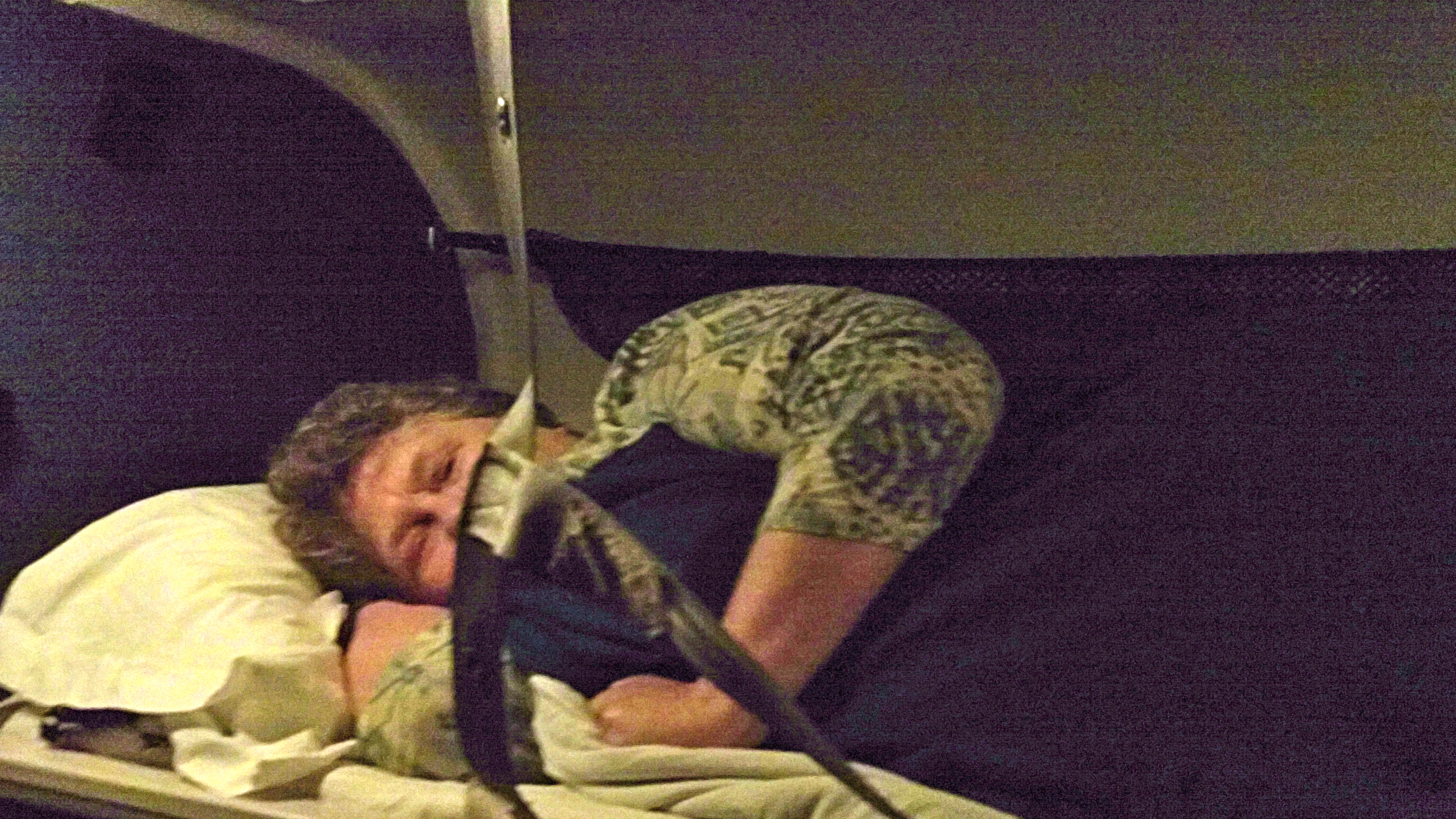
The great adventure was getting ready for bed. Gayle and I have a roomette which converts into two beds, an upper and a lower. The porter comes, pulls a bar under the seat and moves the two seats into a bed. He lowers the upper bunk and pulls down a futon that is already made up for the lower bunk. The best part was me hauling my old, well endowed butt up into the skinny little bunk that looks like a sardine can with one narrow side peeled away. Much laughing ensued as I trudged up the tiny stairs and tried to position my self for sleep. Once I was settled Gayle hooked the safety harness so I would not roll out of bed. Sleeping was only fair, trains shake and wobble with no respect for my comfort. I had suggested to Gayle that we needed to think of it as a big mother rocking us to sleep. I wish that image had been true.

Outside of Denver Colorado we had a two hour delay while they tried to move a damaged train off the track.

On the way to Winter Park we went through 28 tunnels in thirty minutes and then went through Moffat Tunnel. The tunnel is 6.2 mi long. When it was built in 1926 it cut 176 miles off the trip between Denver and the Pacific. It also saved countless hours of snow removal from the tracks.

The rest of the day will be spent on the train watching mountains, canyons, rivers,eagles and fisherman pass our window. The vegetation is becoming shorter- more scrub like the rocks a little redder as we travel farther west.

I have to say this is a lot more seat time then I imagined and the organization is not visible to the naked eye.

On the road again

Gayle Richardson and I left early Sunday morning with the Pittsfield seniors for a tour of the canyon country. The first stop was Chicago.

HOG Butcher for the World,
Tool Maker, Stacker of Wheat,
Player with Railroads and the Nation’s Freight Handler;
Stormy, husky, brawling,
City of the Big Shoulders: (Carl Sandburg)

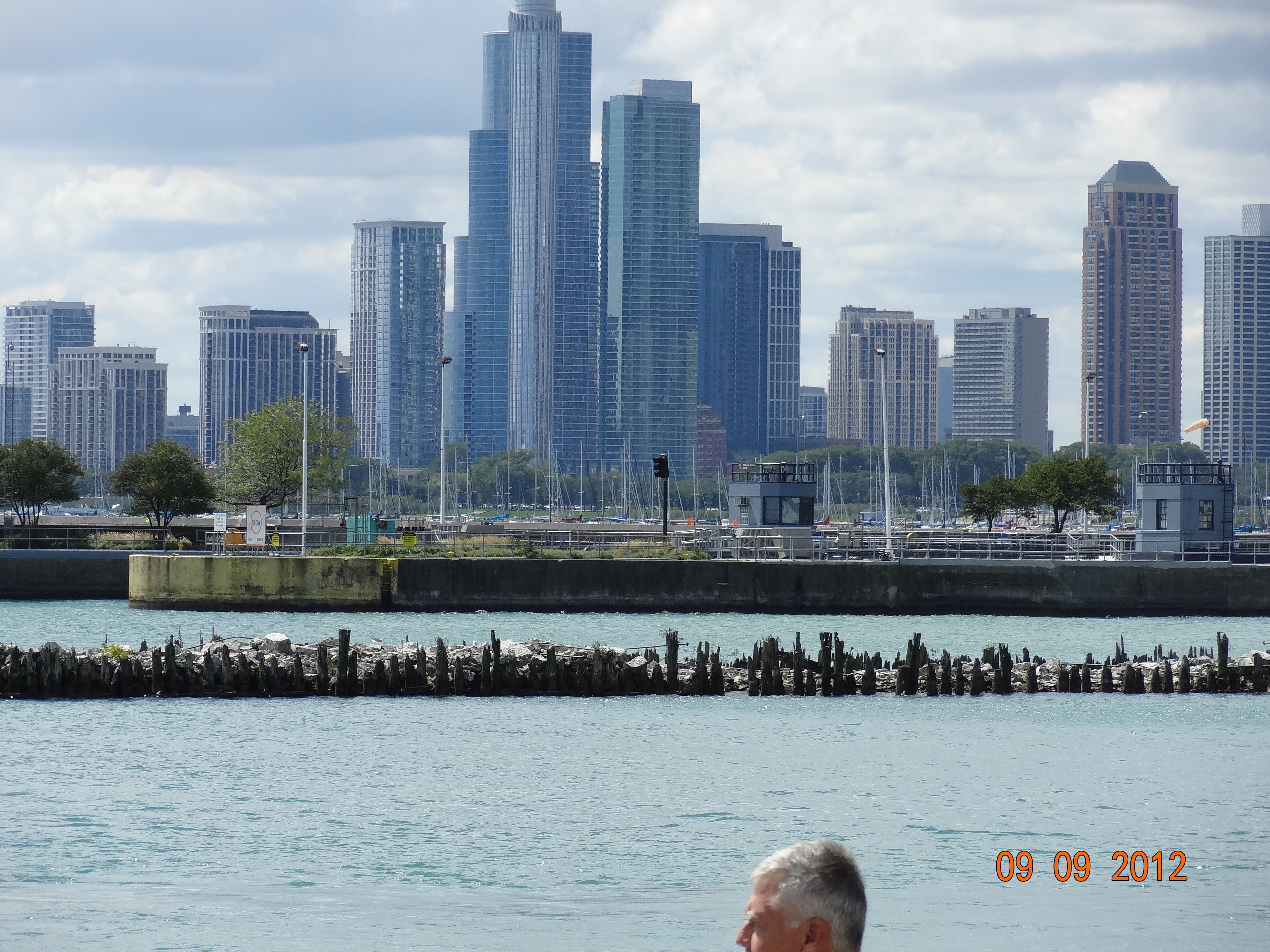
The first stop was Navy Pier. This was not the Navy Pier I remember from twenty some years ago. This was a bustling exciting destination with lots of little shops and restaurants along a beautiful Lake Michigan walkway. Gayle and I walked the entire length of the Pier and ate at The City Porch. We had wonderful fish tacos. I trust it was not the tilapia I saw raised in The Mekong river houses. On the return to the bus we saw the Fabulous Adams Collection of stained glass. Having just finished reading the book,Clara and Mr. Tiffany, I was thrilled to see one of the panels that the women’s shop designed .

We took the afternoon architectural boat tour. The guide was fantastic, full of history, more than I can remember. The most important fact was that the Chicago Fire burned down 3.3 sq miles and gave the city the opportunity to start over with a plan and excellent architecture. Twenty two years later the city had recovered enough to host the World’s Fair wash here they introduced the world to many modern inventions. If you have not read DEVIL IN THE WHITE CITY, it is a a marvelous history of Chicago and it’s famous buildings.

A Tiffany Window

A Tiffany Window

View from the Resturant

View from the Resturant

MONDAY

Today has been a ” hurry up and wait day”. Gayle and I are finally settled in a second story sleeper car for the next Thirty hours.

So far we are seeing first hand the devastation of the drought ( caused by the no such thing as global warming)

The impulse to travel is one of the hopeful symptoms of life.”
–Agnes Repplier,
American essayist