No more tilapia!!!!!

Today we were anchored in Chaudoc. We left on the morning excursion at 8:30 to avoid the heat. We took local river boats to see the Tay An Pagoda and the famous Lady temple at Sam Mountain.

The trip up river was very interesting. The stilt houses made out or corrugated aluminum, the fishing boats, water cress, ” mini- farms” and tons of water hyacinth. The people along the river lost the first crop of rice because of the flooding they will plant a second crop as soon as the river recedes.

The men and women fish with large nets. The fish can be made into eaten fresh,fish paste, or pickled and sold in the market. The pickled fish lasts for several months without refrigeration. Water cress is anchored with Styrofoam and rope so it doesn’t float away. Water hyacinth which we often see in local garden ponds has many uses, food, weaving fiber and a rattan looking material that we use for lawn furniture.

The pagoda was a combination Buddhist, Hindu and Taoist. The pagoda was a tad garish for my taste. Down the street, past the markets, is the Famous Lady Temple.There is a pilgrimage to this temple for three days in March. Visitors offer pieces of gold, roast pig, rice, rice wine and fruit. Prayers are written on paper and burned, the smoke carries the prayer to the Gods. The Famous Lady statue used to ride on the hill but it was brought down for the construction workers to worship during the construction of the canal.

Between the two temples we saw a man drying rice on the street pavement.

On the boat ride back to our ship we stopped at a fish farm. The fish are raised under the house. There are two kinds of fish, catfish ( there are two kinds of farmed catfish, the short whiskers and the long whiskers. They are all shipped to Asia and Europe.) and tilapia.Thousands of pounds are raised under the floor of the floating house. The fish are fed several times a day and it takes six – nine months to reach market weight.
The tilapia
are shipped to the US. We were all grateful that tilapia was not the fish du jour.

Everyday we are seeing barges dredging the river.
I would tell you how there are still many land mines and live bombs left in vietnam, but Mary has told me that Angelie Jolie has already told all of you, and I’m out of the loop.

Tonight we will moor over night in Sadec.

Oat, Oav, Phnom Penh

Monday- oat,oav, oh,another temple, oh, another village. The bad news, the afternoon oav stop Is Flooded so we will spend an extra day in Phnom Penh. In the morning we
Went to another village with more kids, more scarves..

In the afternoon we docked in Phnom Penh. We visited the national museum and took a tour around the city and went to the Russian Market. I am resisting buying souvenirs because I can’t bear to send any more to the recycle center and I have promised myself
That every time something comes in something must go out. Mary snagged opium pipes and coral jewelry.

We returned to the boat and remained anchored in port for the evening. Before dinner we walked. I think this is the first country I have felt it was unsafe to walk. There were fireworks in honor of the kings birthday. He is 90 years old and this is the twentieth anniversary of his second coronation.

In the morning we went to Royal Palace by cyclo. Each member of ship had their own seat pushed by a bike. These poor men cycled all the way to the palace, waited in the street for us to return and then cycled us around town and back to the boat. In the palace we visited the coronation room which houses the throne that is only used for coronations. The hall is used for State visits. The palace is behind the hall but walled off. The silver hall is tiled in large 12 x12 silver tiles… Not ceramic real silver. The hall houses a large collection of Buddhas, silver, gold, marble, baccarat crystal, jade, very small to larger than life.

In the afternoon we went to the killing fields. The genocide led by Pol Pot was brutal. The goal was to eliminate all handicapped, all educated, all creative, and keep only people they could physically and mentally enslave. Children and parents were separated, children were brainwashed to reject their parents and only accept directions from the Khmer Rouge. The torture and methods of execution were barbaric, the regime did not believe the life of these people was worth wasting a bullet to snuff it out. People were beaten against trees, decapitated with the sharp edge of the palm leaf and hung. Based on percents of population this genocide far exceeds the Holocaust. There are several hundred killing fields in Cambodia with numerous mass graves,osiers filled with bones and towers of skulls. The next stop was one of the infamous prisons that had their own unique forms of torture.

In the evening were entertained by young dancers.

Today,which I believe is Wednesday we are sailing all day, no Internet, no stops, only food, more food and drinks that flow like the river. We can see lots of flooded villages.
We will have three programs presented by people on the boat, endangered birds, life in communist Vietnam and making spring rolls.

Early this morning three people left the boat to run. While they were gone the boat left the dock and went to the middle of the river. Watching these people come back to an empty boat slip was really very funny. The tour guide knew they were running and had made arrangements to pull along another ship to retrieve the runners but the runners did not know and stood waving at us from the pier. I’m sorry I have such a sick sense of humor…but believe me there is a back story that makes this even funnier.

Bad karma catches up with me

OMG… Bad karma has hit me the last two days. I accidentally deleted a great day of photos from my camera and the iPad , the iPad crashed while trying to delete all that data. Before the crash my contractor sent an email saying checks I left at home to cover remodeling were bouncing….bad times but all is corrected and back on track.

The pictures lost were from a day of visiting riverside villages. Docking is an ordeal. The community begins to gather on the banks while the crew ties us up and digs or secures to steps for the boarding plank. Once the planks are secure and we????disembark, the children swarm in. “Hello, what is your name, my name is Joe. Look at my mother’s weaving.”. At first they seem very smart but while they hold your hand and walk you thru the village you realize that there is No comprehension the phrases are memorized, they probably know the script in French also. One of the small villages along the river

IMGP0011

After several of us were guilty of slipping some money to the kids the boat guides educated us- one dollar that we give the kids keeps them out of school because five kids begging brings more money to the family than the mom and dad are likely to make that day.

The last village we visited was originally gifted by a Frenchman and then a French NGO. The difference in lifestyle, health and education level is stunning. The water buffalo are fat and sleek, they grow three kinds of rice, the houses are bigger and they have clean water. 140 families live in this cooperative and all the children go to school. There are craft sales but no begging. If I had pictures I would show you a lady carrying rice straw, a herd of water buffalo swimming and the beautiful children.

We also visited an orphanage. At dinner the conversation between Mary and Frank, the ship cynic, centered around the orphanage art work, was it original work of the children or copied by them?

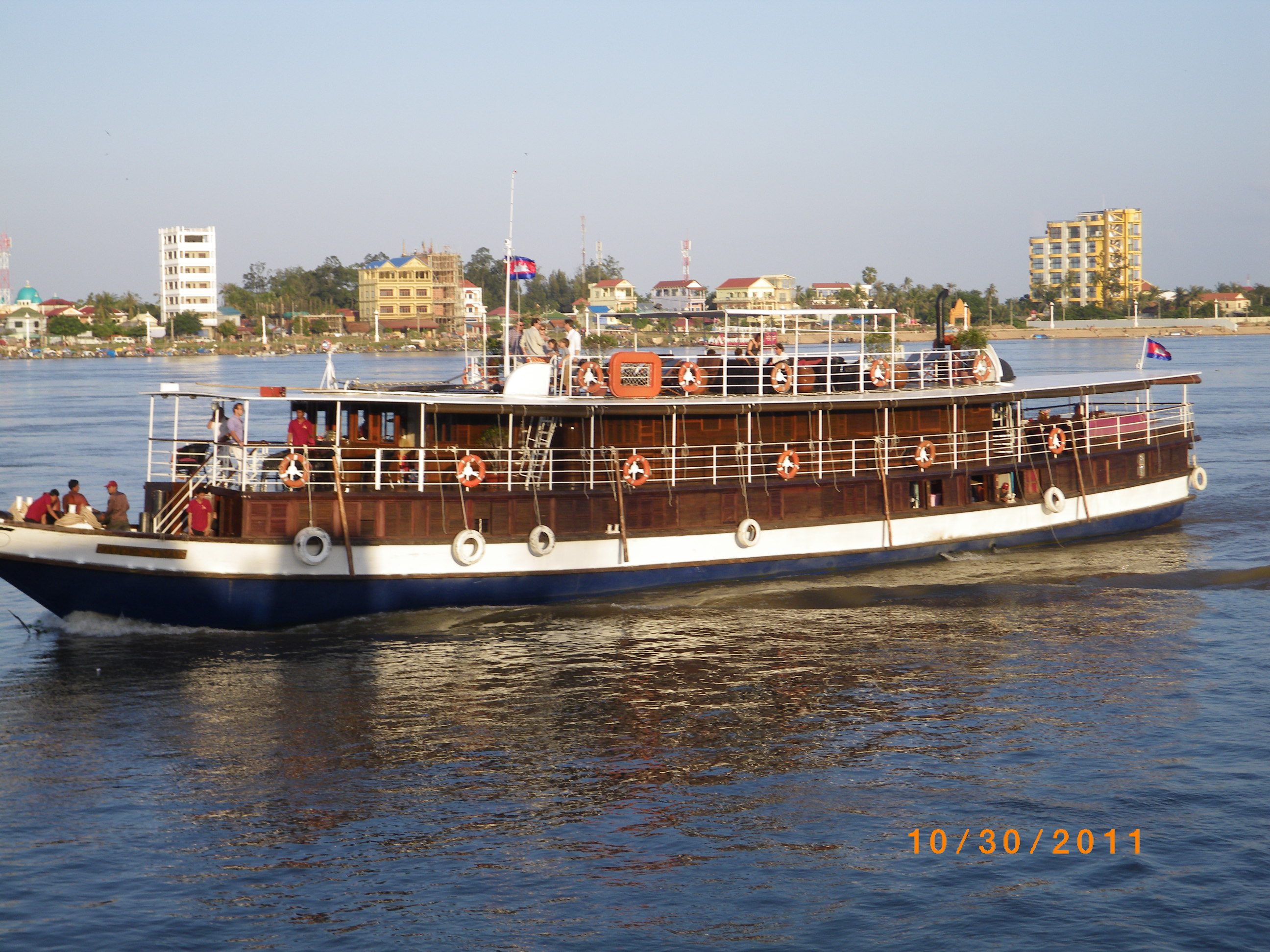
The Boat

The Boat

The Boat

Today we had a five hour bus ride to the boat. The trip began with one unfortunate woman having to stop the bus twice because she was having gastrointestinal problems.

The sights along the road were amazing. The early rice crops are about ready to harvest. Many fields were destroyed by flooding. Another crop is lotus, the flowers are sold at temples, the seeds are a food product and they harvest fish from the rice paddies and the lotus ponds. Houses are built on silts and people live in two rooms during the rainy season. During the dry season people sleep below the house where it is cooler. They burn the rice straw to keep the mosquitoes away at night.

After a potty stop, where we had to walk across a narrow walkway to avoid flooding, our bus air conditioning died. People became very angry and the company had to send us a new bus.

We stopped at a stone cutters market, obviously souvenirs were out of the question.

We arrived at the boat hot and tired. The boat and cabins are lovely if you are not single and assigned to the lower deck. There was one double cabin left so I hooked up with another single woman. The service is fabulous, open honor bar, massage therapy and a gourmet cook who serves three fantastic meals a day. Off the boat the service for the group is also first class. When you leave the bus they give you cold water and when you return they give you more water and a cold compress. The guides are all very knowledgable.

A day of culture

Today was a day to observe the cultural (that they choose to share) and shop.

We began the day at the school of dance. Students who have passed several tests, display potential and are from poor families are admitted for a four year program, a half day of dance and a half day of traditional school. The school was founded by a former dancer who managed to survive the the Khmer Rouge regime. The school is supported by the French government. The students range in age from 8 -12 for the first 3 years. The best stay on longer and the very best are eventually sent to the state university. We observed classrooms and then were entertained by the students.

Eileen was selected from the group as a model to demonstrate the proper way to wear a costume.

Later we went to the silk factory and watched the silk making process from mulberry leaf to finished product. Here they also train the poorer students in the trade. we have had a debate amongst the group about these enterprises or schools that train the poor. My feeling is these kids are very lucky to have a chance to come out of abject poverty. Other members feel like these schools are little more than indentured servitude.

In the evening I went on a cultural event in the country that included an ox cart ride. Mary and Eileen had a massage and shopped.

Susan, we stayed at the Royal Orchid in Bangkok and the Sofitel Siemens Reap. both the hotels are amazing.

Tomorrow we leave for the boat.

This slideshow requires JavaScript.

ANGKOR WAT

Angkor Wat

This amazing complex was built around 1100 was built by King Suryavarman II and the rulers that followed over the century. In the morning we visited the largest and most recognizable of the temples. This is the first one built, construction took about 30 years. It is an example of Khmer art at the peak. Reliefs and sculptures cover the entire complex. Art work was created by slaves an artisans working at a level of perfection that was ensured by their life. Mistakes were not tolerated. Sculptures of dancers are everywhere and each face is unique. The temple was originally a Hindu temple it is now Buddhist and the Hindu gods that remain have been clothed by the local population to preserve modesty. The temple is surrounded by a large manmade moat. The composition of the building is perfectly balanced with a central entrance and two side entrances. Much of the restoration work is being provided by other countries.

After a short break at the hotel we returned to see three other sites within the complex.

The Angkor Thom, Bayon and Ta Prohm. Ta Prohm has been left almost in the same condition as it was discovered. Here is the site where the large kapok tree roots hav engulfed the temple – the picture was used on the cover of the National Geographic Magazine. The amount of growth that covered these temples as one time makes their discovery even more amazing. Several days before we arrived the Indian archeologist uncovered the largest Angkor Buddha at this site. We did not see it because it has been moved by the Indian government for restoration.

Bayon temple marks the beginning of the decline of the architecture. The base is surrounded by bas-reliefs that depict a war between chams and the the khmer.

Angkor Thom has towers with stone faces facing in each of the four cardinal directions.
The majority of the restoration is being completed by the French and Indian governments. The Japanese and Chinese governments are repaving roads and bridges. US does provide aid but the projects do not seem to be as a outstanding as the others who are vying for Cambodian loyalty.

The complex has over 2.5 million visitor a year at a minimum of $20 per person. All money from ticket sales and other venus on the site have been awarded to a friend of the prime minister who bid 2 million dollars a year for these rights.

In the evening we had a lovely dinner at the hotel and we were entertained by traditional dancers.

I am falling way behind on the writing…sorry.

The very slow exit from Thailand

Oct 26

We left Bangkok just in time. The last day the water was definitely rising, people were leaving town and the King declared a five day holiday because crocodiles are entering the town.

The sight seeing on the way to the airport was limited. The Queens summer home which has become a place to display their gifts from dignitaries over the years, many sets of dishes, hundreds of typewriters, elephant tusks and other things that they do not want in the palace. The structure is teak , a wood Thailand over harvested and is now raised in controlled farms. It will be many years until the government sees any return on this project to return teak wood as a viable part of the economy. The King, 85 years old, is loved by the people. He has initiated many projects that will protect the environment and restore the over used land. His health is so fragile that he no longer lives in the palace, he lives in a suite of rooms at the hospital where he can be attended by doctors and nurses on a daily basis.

The next stop was the ROYAL LAPIDARY SHOP. These controlled souvenir buying junkets are part of every trip I have been part of, I suspect that local guides get a kick back on these.

At the airport our flight was delayed for over an hour because the other airports are closed and people are trying to leave Bangkok. The flight to Cambodia was on an old, very small turbo prop.

Our hotel in Cambodia is amazing. It is done in the old french plantation style, a level of luxury I have never experienced but is expected by many other people on this tour. While traveling with teachers on Fulbrights we stayed in clean hotels that were beyond the reach of the average citizen of the country but not luxurious. My fellow travelers on those trips were always very respectful of the natives and eager to converse with and learn from them. I am seeing more ugly american behavior on this tour than I have seen before. Some of my fellow traveler on this trip are part of the now famous 1% and treat the local population with disdain. I do not envy the tour guides, their job is much like teaching, herding us from one venue to the next, repeating instructions multiple times and biting their tongues at some of our ignorant questions.

Water rising

Tuesday

Today we took the bus to the floating markets of Damnoen Sadauk in Ratchaburi.
The drive south and west allowed us to observe several examples of economics in the region. The major source of salt,is sea salt, which is harvested in large drying fields.
The fields are flooded with sea water which evaporates and allows salt to be harvested for sale. There were also rice fields which are similar to those in New Orleans – 100% utilization of the land. Rice is planted, grows and harvested, after the harvest, shrimp are planted on the paddies. The shrimp eat the remnants of the rice fields and fallen rice, the shrimp waste fertilizes the paddies for the next crop of rice following the shrimp harvest. The recycling of wooden houses has also become an industry. With population growth many forests, the source of lumber were lost. Today a person with a wooden house wishing to rebuild may sell the wood to recyclers for about 3 times the cost of building a larger house on the same spot with bricks or concrete. The recycled wood is cleaned and resold for other wood products.

Bangkok used to have a floating market but the population growth and increase in construction, both roads and housing,has closed them down. Because of the high elevation in the north and sea level elevation in the south the Delta region is a series of canals that used to prevent flooding and was a major source of transportation. Just as human settlement and infrastructure growth around New Orleans caused massive flooding six years ago in the United States the flooding this year in Thailand can be attributed to climate change and human interaction with the environment. As construction increased the canals were covered or filled in preventing the monsoon rains from draining without flooding. The floating markets are an example of how life used to be along the canals in Bangkok. We traveled to the market in long boats which have motors with extra long shafts that allow the props to have a shallow draw about two feet behind the boat. Farmers living along the canals raise coconuts and other crops that benefit from the irrigation along the canals. The houses along the canals are built on silts, probably have plumbing that opens directly into the canals and many times had no doors except for tarps covering the opening to the outside. I did see several satellite dishes so they do have television.

Following the market we went to a restaurant called cabbages and condoms.
The restaurant was started by a doctor in the late sixties who was concerned about population growth and the proliferation of Aids Every guest receives a condom and literature about family planning and aids. The restaurant has become a chain and sells very fresh healthy Thai food to support their educational program. It was the cleanest, healthiest place we have been.

On the trip back to the hotel we saw the water rising and beginning to threaten new communities.
at the hotel we heard the airport will be closing at 5pm Wednesday( our flight leaves at 2 pm) and the water from the rising tide inundated the street outside our hotel. This water did recede later in the evening but was higher and faster than we have seen since we arrived.

god willin’ and the creek don’t rise we will be in SEIM REAP Wednesday night as the real threat hits Bangkok.

Buddha, A Massage and a Lesson

DAY 2 October 24 2011

The hotel we are in is very nice. We have a lovely view of the soon to be flooding
Chao Phraya River. The Hotel serves a fabulous breakfast buffet of very fresh eastern and western food. Pancakes, Omelets, pastries, streamed vegetables, seafood, rice filled the buffet tables at the riverside restaurant. After breakfast we had an orientation meeting and met the other people on the tour. Many of them have been on several VANTAGE TOURS.

Following the meeting we went to the Temple of the Emerald Buddha and the Grand Palace built by King Rama 1 when the capital was moved to Bangkok (1782). The grounds are an exquisite mixture of sculptures, temple and the elaborate former palace. The palace is best known to Americans as the site where Anna educated the children of the King of Siam. To capture the grandeur of the gold and mosaic exteriors is impossible. Among my favorites is the statue of a hermit, Buddha’s Physician Jivaka. Sick people used to pound their drug here to increase the potency of the medicine.

The Emerald Buddha was carved from a single piece of Jade and discovered at Chiang Ri in 1434. The Abbot who discovered the Buddha thought it was made of emerald, thus the name.

Later in the afternoon we went to a thai massage parlor.
this was not an elegant massage in a quite aromatherapy filled room. We were divided into groups, couples or gender groups. Our group was four women in a dark room, rather than massage tables there are mattresses on the floor. The masseuse uses accupressure and bending of joints. The experience was enjoyable, not as wonderful as a turkish bath but very relaxing.

Dinner was served at a cultural site, Siam Nimirat Theater. The show that followed was a three act play showing the mythological history of Thailand. Mary, Eileen and I will have to take the word of the others about the first two acts because as soon as the lights went out we all feel asleep. The third act was very colorful, filled with traditional dance, music, moving water, flying and tumbling actors, elephants and goats… We were told there was fire in the first act.. scenes from hell, we are sorry we missed it.

IMPORTANT LESSON LEARNED!! DO NOT try to save time by taking the stairs between two floors in a thai hotel. The doors lock and you are trapped in a concrete stairwell. Pounding on the doors and yelling help only works if you are lucky and a floor maid happens to be walking by.

the journey of a lifetime begins with a thirty hour flight

……. And a hell of a lot of work.

We have arrived at the beginning of our journey. There is evidence of flooding preparation but our hotel, along the river is dry, the ancient capital to the north is under three feet of water and may be completely lost.

Several people who flew in with us have traveled with VANTAGE TRAVEL and have assured us that we are in good hands. Some of these people were so relaxed about travel plans that they had no idea there was flooding.

Trip prep for me has been very difficult. Having begun the month of September determined to do some meaningful work before the trip, I have had my front yard dug up, a major sewer pipe replaced, reseeded the lawn, secured a loan, hired PODS and a moving company and emptied my house. I moved Lumos and her favorite chair to Battle Creek to stay with my sister. I plan on coming back to new floors, fresh paint and several improvements. It became clear during the packing process that I am a borderline hoarder, and one of the worst house cleaners in the world.

LET THE ADVENTURE BEGIN.
5:30 AM, OCTOBER 24,2011